
No detail was omitted when it came to the design of the Market. Architects meticulously crafted a space that felt both grand and approachable. The Market was meant to emulate the beautiful European food halls that many vendors and shoppers knew so well from their adolescence. At the same time, the space intentionally didn’t use expensive materials. This kept the Market feeling integrated in the neighborhood and the everyday environment of its customers.
A Trainless Station
A common misconception about the West Side Market is that the building used to be a train station. The building’s purpose was only ever to house the Market, but this conspiracy is not an entirely baseless claim. There’s a reason the Market looks so much like a train station!

above people 1950
Cleveland Memory Project
“A cathedral for food.”
-Paul Volpe, architect
The Market tile vault was designed by the Gustavino company, who designed vaults for 20+ train stations including the original Penn Station and the iconic Grand Central Station. Additionally, the clock at the top of the tower was designed by the Seth Thomas Company, who also designed the clock for Grand Central Station.
While markets were not these designers’ usual beat, the architects wanted to emulate the feeling that a station provides. A train station is a place for arrival. For the immigrant customers, the station ambiance felt like acceptance into a new place. A train station is a place of radical acceptance and embrace for anyone passing through. This was a principle the West Side Market also wished to adapt.
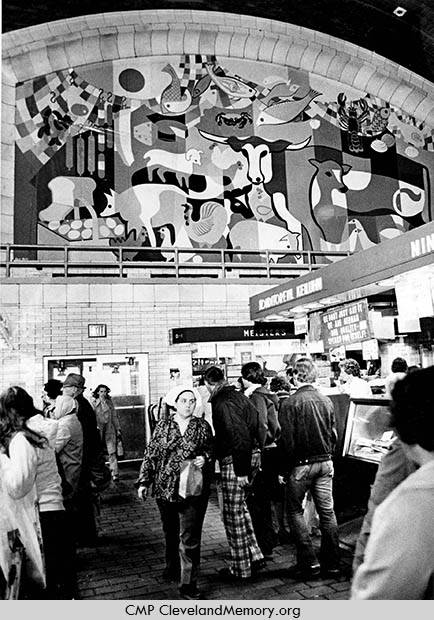
mural hori
Cleveland Memory Project
The West Side Murals
In 1979, the Market commissioned artist Nancy Martt to create two murals to cover the large main windows on either end of the Market. The murals were highly controversial and generally disliked by the public. People found them to not reflect the history of the space.
Martt admitted later on that she had not ever been in the Market herself when she created the murals, and that she would have taken a different approach had she visited prior to their creation. In 2001, the murals were removed. Martt was in aggreeance with this choice.